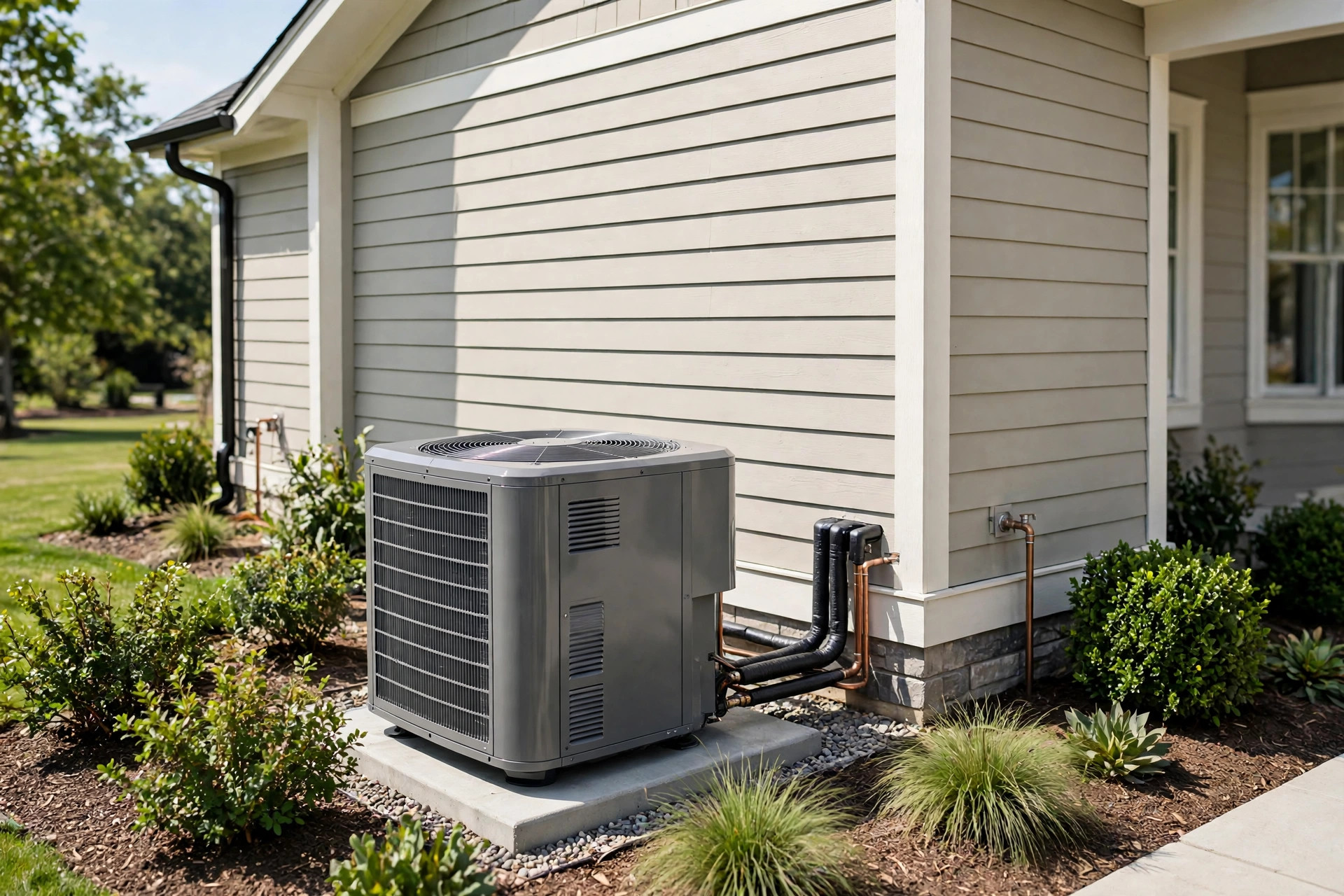

Below: every common repair priced out, the real cost drivers, the repair-or-replace rule technicians use themselves, and how to avoid the upsell on the hottest day of the year.
The Short Answer: What You Will Pay
A typical AC repair visit lands between $150 and $650 all-in, including the diagnostic fee and parts. About two-thirds of repairs fall in that band: capacitors, contactors, thermostats, drain lines, and fan motors. The expensive band, $600 to $1,500, covers refrigerant leaks, blower motors, control boards, and evaporator coil work. The one repair that breaks the scale is the compressor at $1,500 to $3,000, and that is usually the repair that ends the system's life rather than extending it. If a technician quotes you a number far outside these ranges for a standard residential split system, get a second quote before approving anything.
Every Common AC Repair, Priced (2026)
- Diagnostic / service call ($75-$150): The fee to show up and find the problem. Reputable companies credit it toward the repair if you hire them. If a company charges a diagnostic fee and then refuses to credit it, that is your first warning sign.
- Capacitor replacement ($150-$400): The single most common AC repair. The capacitor is the part that jump-starts the compressor and fan motors, and it fails every 5 to 10 years, usually on the first truly hot day of summer. The part costs $20 to $60; you are paying for the diagnosis and the safe discharge of a component that stores a serious electrical charge. Never DIY this one.
- Contactor replacement ($150-$350): The electrical switch that powers the compressor and condenser fan. Pitted or burned contacts cause clicking, humming, or a unit that will not start at all.
- Thermostat replacement ($150-$400): A basic programmable thermostat installed runs $150 to $250; a smart thermostat like Nest or Ecobee installed runs $250 to $400. If your AC runs constantly or short-cycles, a failing thermostat is a cheap suspect worth ruling out first.
- Condensate drain line clearing ($100-$300): A clogged drain trips the float switch and shuts the system down, or worse, overflows into a ceiling. Clearing and flushing the line is quick work; adding an algae treatment tablet or a float-switch safety device costs a little more and prevents the repeat visit.
- Condenser fan motor ($300-$700): The outdoor fan that pulls air across the condenser coil. When it dies, the compressor overheats and shuts down on thermal protection. The motor itself is $150 to $400; the rest is labor and testing.
- Blower motor ($400-$900): The indoor fan that pushes cooled air through your ducts. Weak airflow, a system that runs but barely cools, or a motor that hums without spinning all point here. Variable-speed ECM blower motors sit at the top of this range.
- Refrigerant recharge, R-410A ($150-$600): Topping up a system that is low, typically $100 to $200 per pound plus labor, with most residential systems needing 1 to 3 pounds. Here is the critical part: refrigerant does not get "used up." If you are low, you have a leak, and a recharge without a leak repair is money you will spend again next summer.
- Refrigerant leak detection and repair ($400-$1,500): Finding the leak is the expensive part, especially if it is in the evaporator coil or a buried line set. Coil leaks on older systems often push the decision toward replacement, because the coil alone can cost $1,000 to $2,000.
- Control board replacement ($400-$800): The circuit board that runs the system. Power surges kill these, which is why a $150 surge protector on the condenser disconnect is the cheapest insurance in this entire guide.
- Compressor replacement ($1,500-$3,000): The heart of the system. On a unit under 10 years old with a parts warranty, this can make sense. On a unit over 12 years old, it almost never does, because you are putting a new heart into a body where the coil, fan, and controls are all the same age and will fail next.
What Actually Drives the Price Up
Three things move a repair quote more than the part itself. First, access. A condenser buried behind bushes or an air handler crammed into a low attic crawlspace adds labor time, and labor is $75 to $150 per hour in most markets. Second, refrigerant type. If your system still runs on R-22 (phased out, production ended in 2020), refrigerant alone can cost $100 to $200 per pound or more when it is available at all, and that alone can end an old system's life. R-410A systems are cheaper to service. Third, timing. Emergency, after-hours, and weekend calls add $100 to $300 to the same repair. A capacitor that costs $250 on a Tuesday costs $450 on a Saturday night in July. If the house is bearable with fans and the temperature will drop overnight, waiting until morning is the cheapest repair you will ever make.
Repair or Replace? The Rule Technicians Use
Use the 50 percent rule, then the age rule. If the repair costs more than 50 percent of a new system, replace. A $2,200 compressor on a system whose replacement costs $8,000 is 27 percent, so it passes the money test, but then the age rule kicks in: if the system is over 12 to 15 years old, replace it anyway, because the next failure is already scheduled. The sweet spot for repair is a system under 10 years old with a repair under $1,000. The sweet spot for replacement is any system over 15 years old, any R-22 system needing a major repair, or any system that has needed three repairs in two years. Our AC replacement cost guide has the full replacement math, but the headline is $5,000 to $12,500 for a complete new system, and a new 16 SEER2 system typically cuts cooling bills 20 to 40 percent versus a 15-year-old unit.
Real Scenarios, Real Bills
The capacitor on the hottest day ($250): A 7-year-old system clicks but the fan does not spin. Technician diagnoses a swollen capacitor, replaces it in 30 minutes, total $250 including the diagnostic credit. This is the most common AC repair in America, and it is a good day.
The slow leak ($650, then a decision): A 9-year-old system cools weakly every summer and needs a pound of refrigerant each year. This year the technician finds the leak in a line-set joint: $650 to repair and recharge. Worth it at 9 years old. The same leak at 15 years old would point toward replacement instead.
The dead compressor ($2,200 vs $8,500): A 14-year-old system with a seized compressor. Repair quote $2,200 with a one-year parts warranty. Replacement quote $8,500 for a new 16 SEER2 system with a 10-year warranty and roughly 30 percent lower cooling bills. The math says replace, and so does every honest technician, because the evaporator coil on that 14-year-old system is next.
5 Ways to Avoid Overpaying
- Ask for the failed part back. A capacitor, contactor, or board in your hand is proof the work was done and the part was actually bad. Companies that resist this are worth a second opinion.
- Get the diagnosis in writing before approving the repair. "It needs a new compressor" should come with pressures, voltages, and readings, not just a verdict. A second opinion on any quote over $1,000 is cheap insurance.
- Never approve a recharge without a leak search. A system that needed refrigerant last year and needs it again this year has a leak. Paying for refrigerant twice is paying for the same repair twice.
- Check the warranty before you pay. Compressors often carry 10-year parts warranties, and many homeowners pay for a covered repair because nobody checked. Have the model and serial number ready when you call.
- Put a surge protector on the condenser ($150 installed). It protects the control board and compressor from the power surge that causes the $800 repair. It pays for itself the first storm season.
Get Your Number Before the Next Heat Wave
Run your system size through our free cost calculator for an instant range, then line up quotes from HVAC contractors near you. If your system is blowing warm air right now, our AC not cooling troubleshooting guide walks through the five checks you can do before calling anyone, and our AC maintenance cost guide shows what a proper tune-up should cost so a small problem does not become a $900 one. The cheapest AC repair is the one a maintenance visit catches in April, not the one that finds you in July.